Hiển thị các bài đăng có nhãn John Broome. Hiển thị tất cả bài đăng

Green Lantern #24

Người đăng: lecuongle on Thứ Bảy, 6 tháng 8, 2011


Back in the late 1960s and early 1970s. when I was assembling my collection, I picked up most of my early-mid 1960s DC from a friend of mine named Jon, and his neighbor, Eric. They had long runs of the comics they were interested in, but every now and then there was an issue or two missing. I don't have a clue as to why; perhaps they had just forgotten to go to the newsstand that month, or perhaps they had been broke, or perhaps they had just used the money for a new baseball mitt or something else.

This was one of the issues I never found, and since I wasn't fanatical about completing my Green Lantern run like I was about Batman, it was only a few years ago that I finally found a low-grade copy cheap enough to justify the purchase. IIRC, the first story was reprinted in the 1970s, but I don't think that cover story was until the relatively recent advent of the Archive and Showcase Editions.

The first story is The Shark that Hunted Human Prey. An accident in an atomic station on the coast led to a sudden emission of radiation that hit a passing shark:

Now of course, as far as the science goes, that's absurd. Evolution is a slow, torturous process with many missteps along the way. Still, it's in keeping with the science of comic books, in which Ben Grimm can turn into a pile of orange rocks (and occasionally turn back again).

The Shark discovers he has extraordinary powers, but he retains his essential nature:

After dropping the heavyweight champ without raising a fist, the Shark uses his awesome mental powers to locate a foe worthy of his abilities:

The Shark contacts Hal mentally and issues a challenge. Hal quickly changes into his fighting duds and recharges his ring in the locker room, but:

And for much of the battle that ensues, the Shark maintains his desire to induce fear in Green Lantern. He demonstrates that GL's ring has no power over him as he can block it with his mind. Indeed, his mental powers seem unlimited:

GL realizes that the air in the room is not colored yellow, so he stuns the Shark with a bolt of compressed air. But the Shark recovers and ups the stakes:

His intent was to make Hal afraid, but instead the threat just redoubles GL's resolve to win. He condenses the water vapor in the room and creates a block of ice with which to kayo the villain. Then he uses his power ring to devolve the Shark back into his normal state:

Comments: I found the concept of a shark evolved into a human somewhat ludicrous, and that costume is inane. However, that should not be allowed to obscure the fact that the character development was excellent and the story itself, with the threats to those Hal holds near and dear, is compelling.

The second story is the cover one, and it is pretty simple and straight-forward. While traveling through space, Hal encounters the planet, which suddenly forms a continent that looks like him. It shoots a rocket at him and one grazes him, forcing him to the ground. He encounters visions of Pieface, and several of his enemies. Finally the planet itself finds a way to contact him directly:

It was an intelligent planet who had searched the stars for more intelligence, and GL was the first it had ever encountered. It just wanted to make a friend, but couldn't find a way to express that at first. GL helps it by removing a volcanic core that was causing earthquakes, and they part as buddies.

Comments: Cute story, and the concept of a living planet would be "borrowed" a few years later by Stan Lee and Jack Kirby in the Mighty Thor series.
More about →

Flash #120

Người đăng: lecuongle on Thứ Bảy, 12 tháng 2, 2011


The Flash was probably the most interesting DC hero of the Silver Age. Certainly his comic ran the longest of any of Julius Schwartz's reincarnations; Green Lantern was gone by 1972, the Atom and Hawkman ceased publication (after being merged) in 1969. The Flash made it all the way to 1985.

Given that history, it's worth speculating as to why Barry Allen lasted while the others did not. For starters, it pays to be first; Schwartz introduced the new Flash well before his other re-imagined heroes. The Barry Allen Flash first appeared in Sept-Oct 1956, while Green Lantern debuted a full three years later. Similarly, the first two superheroes from the Golden Age (Superman and Batman) outlasted almost all of their contemporaries.

Second, the Flash had an interesting and colorful rogues' gallery, as shown here (from 80-Page Giant #4):

Third, I would argue that the Flash's ability, running fast, is especially suited to exciting the imaginations of youngsters. Who wouldn't want to be able to tear up the miles rather than having to plod home from school? Who wouldn't want to be able to zip ahead to Grandma's house rather than suffer through the interminable car trips?

One element that was probably not a significant factor, was that the Flash had a juvenile counterpart. While I enjoyed Kid Flash, and especially the "moral" stories that he often appeared in, he didn't show up much in the later 1960s outside of Teen Titans

As you can see from the cover above, this is a Flash/Kid Flash teamup. As the story begins, Barry and Wally West are running late for a yachting trip with Iris and an explorer named Dr. Manners to South America. Dr. Manners is looking for evidence to confirm his belief that South America and Africa were once joined. It's worth noting that this theory was still controversial at the time, although it has now become widely accepted.

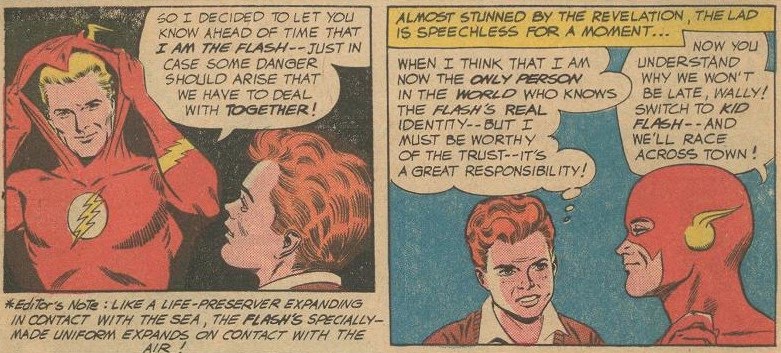
It looks impossible for Barry and Wally to make it to the yacht on time, but Barry reveals that he knows Wally is Kid Flash, as a prelude to disclosing his own secret:

They are delayed a bit when they have to prevent a plane from crashing into a crowded area of the city, but they still make it. On board, they learn that there's a young girl of Wally's age:

I like that Infantino has them rather pointedly sitting on separate couches in that last panel. Dr. Manners explains their mission here:

And in fact the Wikipedia article on continental drift notes that the existence of the same animals on both continents are part of the proof that Africa and South America were once joined (although it's mostly fossils and earthworms that are cited there, not lemurs and aardvarks).

They dock in South America and journey inland. A tribe of natives warn them about a mountain known as the Sleeping Giant, but Iris dismisses it as superstitious drivel. However, as they make their way into the valley nearby, the Sleeping Giant awakens; it was a volcano, which causes earth tremors and rockslides. When the party recovers, they seem to have been transported far away, as the Sleeping Giant is nowhere to be seen.

Barry and Wally discover something odd:

They volunteer to do a little scouting around, not telling Dr Manners that it will be in their crimson uniforms. They come upon a caveman being threatened by a giant bird, and save him. But what are cavemen doing in modern times? Later, they see paintings of prehistoric animals created by the cave people. Have they stumbled into a valley that time forgot? They also learn that the primitives fear a giant named Grodan. And sure enough:

Flash vibrates his way free of the giant. He and Kid Flash use some cables that had been brought on the expedition to truss up the behemoth (as shown on the cover). Then Barry realizes that they are not in some hidden valley that has been missed by civilization; rather they are literally in the past. Sure enough, as they do some more exploring:

Okay, so that's a bit of artistic license. The dinosaurs in fact became extinct about 65 million years ago, well before the time of cavemen. Flash and his younger counterpart race around the globe, establishing that the continents were indeed joined at this period in time. But at that moment the earthquakes begin that separates the continents. They dash off to help the cavemen, who are under attack by the giants. But:

The actual phrase is, "there were giants in the earth in those days..." and it comes from the Book of Genesis in the Old Testament.

Barry and Wally rush back to their expedition and try to set up duplicate vibrations to the original earthquake that transported them to the past. We get a rather psychedelic panel here:

And then they're back in the present day (well, 1961 anyway). Dr Manners has photographic proof that the continents were joined, and the juvenile romance subplot has been resolved:

Comments: A terrific and entertaining story by John Broome and Carmine Infantino, with only the occasional anachronisms as negatives.
More about →

Green Lantern #59: Guy Gardner

Người đăng: lecuongle on Thứ Năm, 22 tháng 10, 2009


This story starts with Green Lantern visiting Oa, the planet of the Guardians, for a seminar in advanced Green Lanternship. Hal learns that the Guardians have a machine that can read the minds of dead people. They offer to show him the last thoughts of Abin Sur, the alien Green Lantern who crashed on Earth and offered Hal Jordan the chance to take his place. Abin Sur had two requirements for a suitable replacement. The candidate must be honest and he must be utterly without fear.

To Hal's surprise (and ours) it turns out there were two possibilities: Hal Jordan and Guy Gardner. But as Jordan was on the West Coast, while Gardner was back east, Abin Sur chose Hal. We get the familiar origin sequence:


Hal is intrigued. What would have happened if Guy Gardner had been chosen as Green Lantern? Well, funny you should ask, because the Guardians just happen to have a "What If" machine:


Of course the same type of machine features in two of my favorite Silver Age stories, The Second Life of Batman from Batman #127, and Superman's Other Life, from Superman #132.

Gardner's home base is "East City" continuing DC's coy tradition of fictional town names. Guy's occupation is quite a bit different from Hal's:


They both sure like to punch! We found he would have battled pretty much the same crime gallery: Sonar, the Shark, Black Hand, Dr. Polaris, and Sinestro are shown. But when the Gardner GL returns to Earth following his initial meeting with the Guardians, he takes a slightly different route, and this is where history starts to diverge. He encounters two robots battling, one orange and the other blue, and learns from them that they come from a planet where the Yellow Plague killed off all the adults, and where the children do not age normally, so they have divided into two warring factions.

When Guy first visits the planet he is controlled by the mental powers of the blue faction, but during a battle with the "Orangers" he breaks free and manages to shield his mind from control. After that, it's a pretty simple matter for the gym teacher to get the kids to behave properly, especially since his ring ensures they will start to mature.

Unfortunately:


Guy Gardner must summon another worthy individual, who just happens to be Hal Jordan. Again, this perfectly echoes the Batman and Superman tales, both of which ended with Bruce wearing a cowl and Kal in a cape.

There is a very nice bit at the end. Hal asks for permission to form a friendship with Earth's other Green Lantern and they hit it off after meeting at Guy's health club:


Comments: Cute idea, but it did not get developed in the Silver Age after this; Guy Gardner popped up in a Green Lantern/Green Arrow issue and then basically disappeared until the mid-1970s. But he would become a major character in his own right, with his personality more like the cover of this issue than the ending.
More about →