I've been working my way through the mid-1950s issues of Superboy, looking for more stories that were later swiped by Weisinger, and the first one I found is rather significant.
Did you know that Pete Ross' original name was Billy Todd? He popped up in Superboy #47 (March 1956). When we meet him, Billy is helping Clark deal with some bullying:
 Just as Pete did in Superboy #86 (January 1961):

He offers to be Clark's pal, but the Boy of Steel is too worried about protecting his secret identity. Fortunately, Ma and Pa Kent intervene, inviting the new chum to dinner. After the meal, Clark shows off his hobby:
 As he would later to Pete.
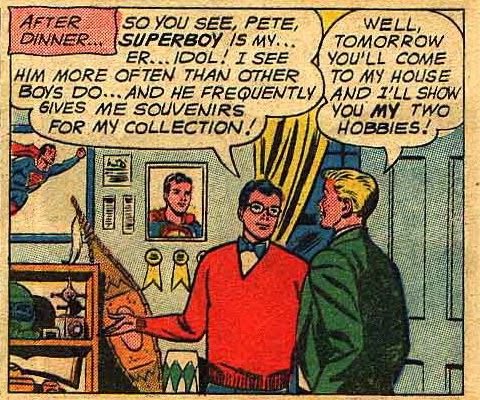
Billy later shows off his own hobby, which is creating miniature replicas of famous structures, such as the Eiffel Tower, the Empire State Building, and the Golden Gate Bridge. Pete has different pastimes: acting and detective work.
Now that they are friends, Clark finds himself (as Superboy) often saving Billy from perilous situations:
 As he also did with Pete:

Which leads inevitably to some awkward moments:


Clark is disturbed to learn that his new pal is checking Superboy's measurements:


Which leads him inevitably to the conclusion that his supposed buddy is plotting to betray him. But fortunately there is an innocent explanation:

 Pete Ross went on to become a recurring character in the DC Silver Age, albeit a minor one. As I have discussed earlier, he became the only person other than Ma and Pa Kent to know Superboy's secret identity. Billy Todd? As best as I can tell, this was his only appearance.
Update: Kirk House pointed out in the comments that in Action #457, Pete Ross's son apparently lost his will to live. Only one thing could save him; if Superman divulged his secret identity to the young lad. The story is pretty good; ironically the many times that people have suspected Clark Kent as Supes works against the disclosure, as Jon Ross cites those incidents for his skepticism. Fortunately he has figured out another way to prove it that Clark had not protected himself against:
 There are a couple of interesting ironies about this story. First, Pete could have told his son that Clark was Superman, or at least confirmed it, except that Supes himself was unaware that his boyhood chum knew the truth. Second is that the many times Clark had been suspected of being the Man of Steel and managed to deceive people into reconsidering actually worked against him. This echoes a Golden Age Batman story where Bruce Wayne lost his position as the guardian of Dick Grayson, in large part because he had convinced the public that he was a dissolute playboy.
The concept of someone making a deathbed request to learn a superhero's secret ID had been used several times already, including at least two Batman tales and one in Jimmy Olsen:

More about →
Did you know that Pete Ross' original name was Billy Todd? He popped up in Superboy #47 (March 1956). When we meet him, Billy is helping Clark deal with some bullying:
He offers to be Clark's pal, but the Boy of Steel is too worried about protecting his secret identity. Fortunately, Ma and Pa Kent intervene, inviting the new chum to dinner. After the meal, Clark shows off his hobby:
Billy later shows off his own hobby, which is creating miniature replicas of famous structures, such as the Eiffel Tower, the Empire State Building, and the Golden Gate Bridge. Pete has different pastimes: acting and detective work.
Now that they are friends, Clark finds himself (as Superboy) often saving Billy from perilous situations:
Which leads inevitably to some awkward moments:
Clark is disturbed to learn that his new pal is checking Superboy's measurements:
Which leads him inevitably to the conclusion that his supposed buddy is plotting to betray him. But fortunately there is an innocent explanation:
Update: Kirk House pointed out in the comments that in Action #457, Pete Ross's son apparently lost his will to live. Only one thing could save him; if Superman divulged his secret identity to the young lad. The story is pretty good; ironically the many times that people have suspected Clark Kent as Supes works against the disclosure, as Jon Ross cites those incidents for his skepticism. Fortunately he has figured out another way to prove it that Clark had not protected himself against:
The concept of someone making a deathbed request to learn a superhero's secret ID had been used several times already, including at least two Batman tales and one in Jimmy Olsen:


