Hiển thị các bài đăng có nhãn Wonder Woman. Hiển thị tất cả bài đăng

Wonder Woman 155

Người đăng: lecuongle on Thứ Ba, 2 tháng 8, 2011


Even by the standards of the Silver Age Wonder Woman, that's a mind-boggling cover.

Back in the 1960s, young boys were off in the woods, playing army, possibly the dumbest game ever invented. Girls tended to want to play house, which certainly seemed dumb, but they were actually practicing the roles they were expected to grow into. The hope was that they would find a good man and settle down, just like Mommy had. Of course, there was also the fear that they would fall for the wrong man, or that only the wrong types would want to date them.

These hopes and fears were expressed and marketed to in many ways. For example remember the girls' board game, Mystery Date?

Note the reaction from the girl when she opens the door to discover the "dud" waiting to take her out. One of the amusing things about this ad is that by the 1970s, when these girls were dating for real, most of them were likely to date someone even more shabbily attired than him.

The covers of Lois Lane are filled with images of her falling for the wrong man:


The Wonder Woman story starts out similar to Wonder Woman #125, which I reviewed a few years ago. She's having problems with the men in her life being too aggressive:

She has similar encounters with Bird-Man and Manno, the Merman, during the latter of which we learn an interesting fact about Wonder Woman's physiology:

There's also this amusing bit:

King Kong's escaped again? What a pain!
She also gets some unwanted attention from an octopus. You have to see it to believe it:

So after all that excessive affection, she is intrigued when she meets a monster prince who rejects her friendship:

But when he destroys his castle during a battle with the Amazons who've come to befriend him:

We learn that's the real way to Wonder Woman's heart:

And she decides to marry him. There's an interesting statement on prejudice here:

Wow.

And so we get the scene on the cover. But at the last moment the groom gets cold feet:

There follows a zany sequence where a flying sphinx attacks her, and the monster helps save her and turns into a handsome dreamboat. But as they are falling off a cliff, he gets angry again and changes back into his monster self and rejects her, leading to this denouement:

Comments: Obviously the story is an insane remake of Beauty and the Beast. But it is redeemed a bit by the positive characterization of Wonder Woman.
More about →

Wonder Woman 156--Return of the Golden Age

Người đăng: lecuongle on Thứ Sáu, 29 tháng 7, 2011


One of the things that I've been meaning to do is look back through the comics to see when the concept of comics being "collectibles" first started; this must be a fairly early example, with an August 1965 cover date. Marvel Collectors' Item Classics started the same month, so obviously by then the news was getting out about the value of the older issues.

This issue also demonstrates the growing influence of fandom. In 1961 and 1964, Wonder Woman was selected by the Alley Awards as the "Worst Comic Book Currently Published."
While that is a bit unfair, I suspect what the fans were getting at was more like "The worst comic that used to be good."

In response, Robert Kanigher decided to give the fans what they wanted; a Golden Age-type story with Golden Age-type artwork. Does it work? Mostly it does. Oh, it's zany, but the GA Wonder Woman was quite wacky. The story starts out with Steve Trevor telling Diana Prince that he always knew his Wonder Woman was worth a million, and now he has the proof:

How'd you like to be able to buy early Golden Age issues for $100 per copy?

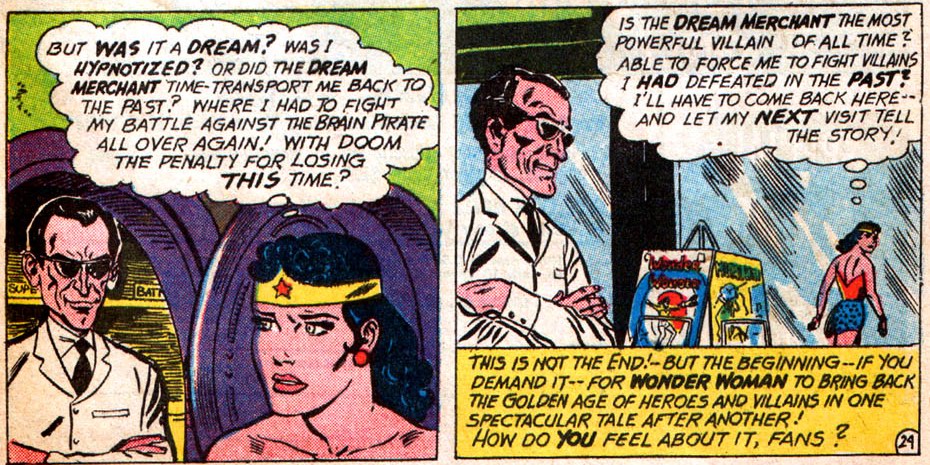
Intrigued, Wonder Woman visits the Dream Merchant (a fictional comic book shop). She starts reading an old comic and suddenly finds herself pulled into the story:

Incidentally, although the Brain Pirates were featured in a Golden Age Wonder Woman story in Sensation Comics #82, there is only a superficial similarity between that tale and this one.

The Brain Pirate tries to steal Wonder Woman's brain, but she throws off his control. However, he succeeds with Steve Trevor:

There follows a zany battle with the pirates over Steve's "brain"; at one point they load it into a cannon and threaten to fire it far out to sea. She prevents them from doing that, but she's stymied when they control Steve and order him to shoot her if she does not submit:

Just then the Holliday girls and Etta Candy happen to be rowing by, and the pirates threaten to ram them. Wonder Woman prevents this:

Err, but isn't she supposed to be only as strong as a normal woman when her bracelets are welded together? She returns to the pirate ship and is there when the Holliday girls attempt to rescue her by swimming to the ship. But the Brain Pirates capture the girls' brains, and the ship takes off for outer space.

After landing on the Brain Pirates' world, they torment Wonder Woman by making all the passengers walk the plank, into a shark-infested sea. Wondy fights off the sharks, and saves Steve and the Holliday girls:

She gets them safely to land, but the Brain Pirates still control them and force Steve and the girls to capture Wonder Woman. The BPs parade their slaves into their city. They attempt to kill Wonder Woman but she manages to avoid their spears and swords. Then comes the dartboard scene shown on the cover. She manages to get a dart to pierce the chains holding her bracelets together, and now she's free. The leader of the Brain Pirates makes a deal:

Except, as you can probably guess, the brains of Etta, Steve and the Holliday Girls are inside that box. Fortunately Wonder Woman realizes this, grabs the box and her friends, calls for her plane, and gets everybody safely back to Earth. And in the end Wonder Woman pops back out of the comic and into the store where she ponders:


The next two issues were done in Silver Age style and featured the memorable Egg Fu. Wonder Woman #159 featured a retelling of the origin of the Amazon princess, and Golden Age-style art, and Kanigher continued the experiment until #165, when the Silver Age artwork returned. Kanigher noted in the letters column of #166:
More about →

Single Issue Review: Justice League of America #15

Người đăng: lecuongle on Thứ Bảy, 12 tháng 9, 2009


As the story begins, the US is testing a "Star Wars" weapon:


Yet another example of Gardner Fox being ahead of the curve on technology. The satellite base containing the cannon in the sky is filled with reporters and military personnel including Diana (Wonder Woman) Prince and Clark (Superman) Kent. Suddenly the satellite comes under attack and the pair have to save other people. Superman observes that some strange force is yanking the atomic cannon away from its base, but he and Wonder Woman are too busy to follow it.

Barry (the Flash) Allen observes the cannon being aimed at the tallest building in Central City (the Wilmoth Skyscraper), and hurriedly changes into his fighting togs. Using his super-speed to gather up the tenants of the building he empties it before the cannon can fire:


After the cannon is fired once, Superman and Wonder Woman arrive. Although nobody seems to be operating the big gun, it fires again, and Wonder Woman diverts the missile into space with her lasso. Since they can't stop whoever's firing, they destroy the cannon itself. To solve the mystery, an emergency meeting of the Justice League is called. They learn that similar incidents are happening elsewhere:


The JLA split up into teams. Green Arrow, Aquaman and the Martian Manhunter journey to Japan, where they discover a giant stone idol watching the heavens. The idol smiles when it sees an atomic missile headed for Tokyo. At first, J'onn J'onzz plans to use his super-breath to blow it out into space, but the idol reacts quickly:


Fortunately, Green Arrow is able to use his parachute arrow to get the missile to land harmlessly in Tokyo Bay. Aquaman prevents another attack on the city by an underwater stone idol. However the three of them are captured by the idols and apparently about to be killed, when suddenly the stone giants disappear.

Meanwhile, Superman, the Atom and Wonder Woman have traveled to Brasilia, where they also discover the giant idols. The weapon the giants intend to use on this city is acid rain (once again, Fox is ahead of the general public):


The Atom manages to get into the rain-maker and destroy it, but again at the end of the segment the three heroes are captured by the stone giants, who suddenly disappear.

The final JLA team consists of Green Lantern, Flash and Batman, and they head to Central City, where they find a pair of stone idols trying to destroy the local skyscrapers with an earthquake machine. Green Lantern holds up the building with hands projected from his power ring, while Batman and the Flash go after the idols:


Pretty bad perspective there; obviously Batman is supposed to be far behind the Flash, accounting for their difference in size. The giants capture both of them, but at the same time, GL destroys the earthquake machine. Once again, the idols grab all three heroes, but quickly disappear. However, they take Green Lantern's ring with them for study.

We learn that the giants are actually scientists on another Earth, one that is one minute ahead of ours. Due to an atomic explosion on Earth and a cobalt explosion on their world, the time differential between the two worlds is decreasing, and when they reach synchronicity at three separate cites (Brasilia, Tokyo and Central City):


Green Lantern has ordered his power ring to bring him, Batman and the Flash to the stone giant's world after reading their minds for five minutes:


But it turns out that the giants have sabotaged their cities so that in the event of an alien invasion, they will be destroyed. Fortunately GL realizes this in time and decides to simply fix both worlds so that they are again one minute apart (nice to have a power ring that handles this sort of complex stuff with just a thought). And in the end, the JLA realizes that the stone giants were just like them, only different:


Nice sentiments by Wonder Woman, and the call for tolerance is pretty early; this issue is cover-dated November 1962. If anybody has any idea what Snapper Carr was saying, let me know!
More about →