The Continuing Dilemma of Brainiac 5

Người đăng: lecuongle on Thứ Tư, 18 tháng 1, 2012

Mort Weisinger and his writers had continual problems with the Legion of Super-Heroes.  In a way, this is not terribly surprising.  The Legion was initially intended for just one story, the original tale in Adventure #247.  But a few issues later, Mort began putting letters pages in Adventure, and while I haven't been able to locate any letters that were actually published, it seems logical to assume that at least some fans wrote in requesting a return of the superhero team.  And so, over time, they became a regular part of the Superman family, eventually supplanting Superboy himself as the cover feature in Adventure.

But the process was not without some growing pains.  Because the stories had been written on an ad hoc basis, there were contradictions here and there.  For instance, in the initial story, the Legion was set 1000 years in the future:
But in some stories, the Legion was set only 100 years in the future.  This seems like a minor problem, except for one thing.

In Action #267, Weisinger gave Supergirl a tryout with the Legion.  However, either he or his writer for that story, realized there would be problems with having Supergirl and Superboy in the same club.  After all, wouldn't Superboy then know that a Supergirl would arrive on Earth several years later?  So they made the Legion that Supergirl tried out for the descendants of the original LSH:
As I have discussed in the past, when DC reprinted that story years later, they edited the text, so that Supergirl was joining the same Legion.  In the interim between the two appearances, Weisinger had come up with a solution to the dilemma of having Superboy know of the existence of a Supergirl in the future.  Supergirl had hypnotized him into forgetting her except when he was in the future.

But there was another problem that popped up that never was resolved in the Silver Age. Supergirl actually was rejected for membership in the Legion in that first story, although there was a reason.  She had been exposed to Red Kryptonite, which turned her temporarily into an adult.  Since the Legion was for teenagers only, she was unable to join that time.

She finally made the grade in Action #276.  In that issue, she met another applicant, with a strangely familiar appearance:
Note that the coloring in that panel is in error; for most of the story, Brainiac 5 has a green face, like his ancestor (and like his hands).  Also note that the numbering appears wrong; Brainiac's son would be Brainiac 2, his grandson Brainiac 3, his great-grandson Brainiac 4 and his great-great-grandson would be Brainiac 5.  So his great-great-great-great-grandson should be Brainiac 7.  Of course, the possibility exists that only male descendants of Brainiac inherited the name. 

But the problems don't end there.  Remember, this story is supposedly taking place 1000 years in the future.  Unless the Brainiac clan has an extraordinary lifespan, wouldn't his great-great-great-great-grandson be living more like 150 years in the future, rather than 1000?  A likely explanation is that the writer thought the Legion was only 100 years in the future.  A generation is usually considered to be 20 years, Brainiac 5 (ignoring the great-great-great-great grandson mistake) would be around 100 years after his ancestor.

A further dilemma was introduced in Superman #167, when we learned:
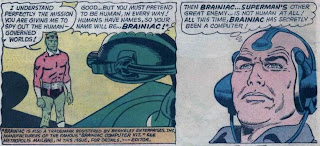
Weisinger and his writer had a ready explanation for Brainiac 5:
Except that doesn't really explain anything.  For starters, if Brainiac II escaped and despised the original Brainiac, why would his descendants continue to be named after the computer?  So maybe they did find him and brainwash him into thinking that Brainiac was indeed his father.  But there's still a problem. Remember, Brainiac 5 supposedly had a super-genius mind; that was his super-power that got him into the Legion.  But Brainiac II was just an ordinary boy (from a planet where the inhabitants had green skin).  How did his descendants get so smart?

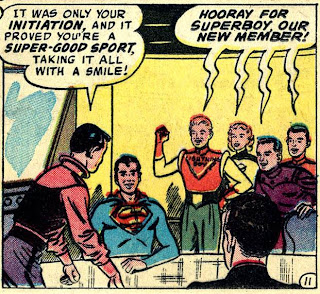
By the way, DC has now apparently decided to ignore the story in Action #276.  Remember, this was the story that showed Brainiac 5 and Supergirl getting inducted into the Legion:
But in modern reprintings of Adventure #247, the original Legion story, one of the characters in several panels has been recolored to look like Brainiac 5.  For example, in the Millenium edition:
But in the original there was no green-skinned lad:
More about

Flash Fordon Sunday strips: S178 - "Princess Simila" (10/14/90 to 8/11/91)

Người đăng: lecuongle on Chủ Nhật, 15 tháng 1, 2012

Enjoy Sunday strips by Ralph Reese Bruce Jones & Gray Morrow (1990–1991)!
I think, it's S178 - "Princess Simila" (10/14/90 to 8/11/91). 


The contributor "Durgesh Velhal" says:
hello sir, these strips are collected from newspaper. 4 strips are missing, but that's not my fault because the newspaper had skipped those strips.


Mediafire Link (1600 px width)
More about

Around the Horn

Người đăng: lecuongle on Thứ Bảy, 14 tháng 1, 2012

Been awhile since I did a roundup post, so here we go:

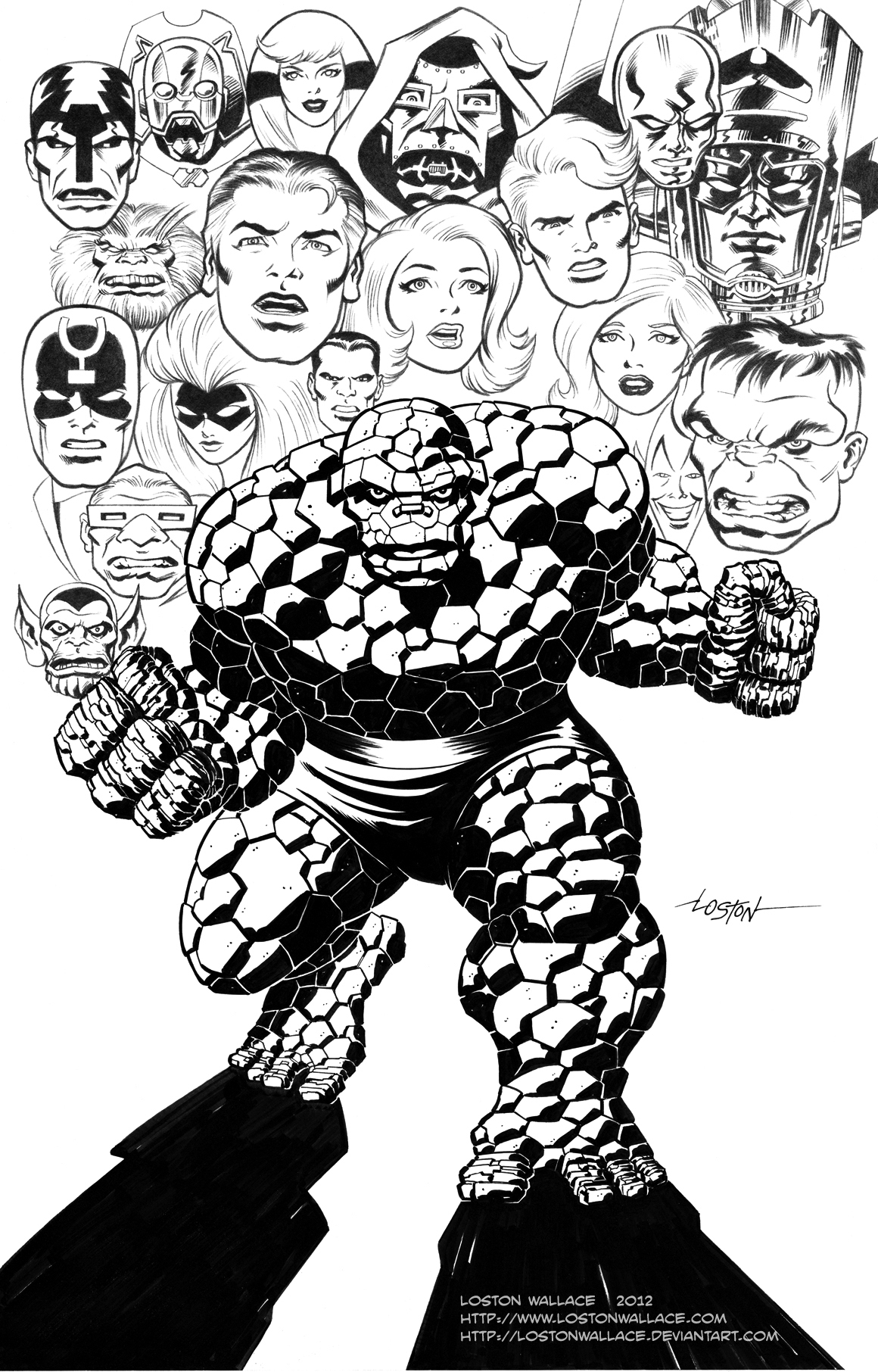
Loston Wallace created a terrific picture of the Thing, featuring the other members of the FF and some of their more memorable antagonists.  I wish I had that kind of talent; even my stick figures look bad.

Commander Benson has a post up about how the death of Bucky Barnes was covered in the Silver Age. I read all those stories out of order, so it's nice to see someone put it together chronologically.  I like this observation:
For nearly forty years, despite all the times Marvel had tantalised Captain America and the readers with “Bucky Returns!” plotlines, the true Bucky Barnes had remained really, most sincerely dead.  So certain was this that the comics fanship coined the term Bucky-dead for any character perceived to have been killed off permanently, with no chance of revival.
Blog Into Mystery blogs the wedding of Barry and Iris back in 1966, and points out a very interesting and early Easter Egg on the cover of that  issue that I'm ashamed to admit I missed entirely up until now.

Booksteve covers the Marvel Universe 50 years ago this month.  Of course, back then there were only two comics that really qualify as Marvels, and one of them comes with an asterisk.

A 324-page comic book for Christmas?  And no, it's not one of the Cerebus phonebooks, it's a Golden Age comic featuring Captain Marvel and other Fawcett superheroes.
More about

राग दरबारी (Raag Darbari) by श्रीलाल शुक्ल (Shrilal Shukla)

Người đăng: lecuongle on Thứ Sáu, 13 tháng 1, 2012

Before I start posting some rare strips, sharing a Hindi book for online reading. It's a worth book for collection. If you read this book once, always like to open again and again.

Two words about this book: Raag Darbari (Melody of the Court, one of the ragas, 1968) is one of the most famous Hindi novels written by Srilal Shukla, an author known for his social and political satire. 

Shrilal Shukla (1925 - 2011), an IAS officer, is renowned for his objective and purposive satire in contemporary Hindi fiction. In 1957, he published his first novel, Sooni Ghat ka Sooraj (The Sun of a Desolate Valley) followed by a series of satires Amgada Ka Pamva (Angada's Foot) in 1958. His Raag Darbari  is the first satirical novel of its kind in Hindi spanning a wide spectrum of post-Independence rural India, specifically Avadh. It was Shrilal Shukla who took wit, irony and sarcasm to great heights in Hindi literature. He was awarded the Sahitya Academy Award, the highest Indian literary award, in 1970 for this novel.

Novel on deteriorating values in the cities of India as compared to the village life. The novel highlights the failing values present in post-Independence Indian society. It exposes the helplessness of intellectuals in the face of a strong and corrupt nexus between criminals, businessmen, police and politicians. Though a lot has changed in 40+ years since the book was first written, but you can see almost everything even today. The core of our society has not changed. 
Page 1: शहर का किनारा। उसे छोड़ते ही भारतीय देहात का महासागर शुरू हो जाता था। वहीं एक ट्रक खड़ा था। उसे देखते ही यकीन हो जाता था, इसका जन्म केवल सड़कों के साथ बलात्कार करने के लिए हुआ है। जैसे कि सत्य के होते हैं, इस ट्रक के भी कई पहलू थे। पुलिसवाले उसे एक ओर से देखकर कह सकते थे कि वह सड़क के बीच में खड़ा है, दूसरी ओर से देखकर ड्राइवर कह सकता था कि वह सड़क के किनारे पर है। चालू फैशन के हिसाब से ड्राइवर ने ट्रक का दाहिना दरवाज़ा खोलकर डैने की तरह फैला दिया था। इससे ट्रक की खूबसूरती बढ़ गई थी, साथ ही यह खतरा मिट गया था कि उसके वहाँ होते हुए कोई दूसरी सवारी भी सड़क के ऊपर से निकल सकती है। .........
 ............ आज रेलवे ने उसे धोखा दिया था। स्थानीय पैसेंजर्स ट्रेन को रोज की तरह दो घण्टा लेट समझकर वह घर से चला था, पर वह सिर्फ डेढ़ घण्टा लेट होकर चल दी थी। शिकायती किताब के कथा-साहित्य में अपना योगदान देकर और रेलवे अधिकारियों की निगाह में हास्यास्पद बनकर वह स्टेशन से बाहर निकल आया था। ..........
 Every page of the book has humour. The language and humour stood out everywhere, both in dialogue and in narration.

Note: The English translation published by Penguin Books is also available. Didn't read translated version myself, so just check before buying.


More about

When I'm the Evil Genius...

Người đăng: lecuongle on Thứ Hai, 9 tháng 1, 2012

I will not regret that they have no chance:
For previous installments in the When I'm the Evil Genius series, click here.
More about

Forbidden Worlds #108

Người đăng: lecuongle on Chủ Nhật, 8 tháng 1, 2012

The first story presents the usual Silver Age characterization on the fly:
We can get a quick sense of Caton from just those two panels; kind of a wimp and yet it's not really his fault, so we also sympathize with him.  We subsequently learn that he has one particular tormentor: Bat Jennison, and a love object: Celia Jones.  When he grows up, he applies for a job at the local rocket plant:
Okay, so Celia isn't really his type.  Bat decides to pull a prank on him.  He gets several buddies to dress up as generals.  They tell Caton that the astronaut scheduled for the next mission has taken ill, and that they have decided that he must take the rocket jockey's place.  They strap him in and put a firecracker under his seat, knowing this will scare him thoroughly.  It succeeds, so well that Caton is blown out of his seat and lands on the rocket's firing mechanism.

When the rocket finally lands on another planet, Caton discovers that the humans there have patterned their civilization after Earth's medieval period, with knights in armor.  He also learns that he's tremendously strong and has other powers:
And when the princess is threatened:

He wins the heart of the princess, but one thing makes him miserable.  When he returns to Earth, he'll go back to being a weakling.  Fortunately she has a wizard who can take care of that:
And when he gets back on the rocket, he's pleased to discover that the princess has joined him.  When he gets back to Earth, he's a big hero, but Bat still intends to bully him.  Bad idea:
And with a princess won, he has no interest in Celia Jones when she flirts with him.  He even wins first prize in the company costume ball, dressing up as (what else?) a knight in shining armor.

Comments: Cute story.  Writer Richard Hughes did a lot of these types of tales, where the hero takes a trip (often to another planet) and comes back with new confidence and drive.  It's not hard to see the appeal to adolescent boys, who were often subjected to bullying and the scorn of the girls they adored.

The next tale concerns a chemist who works for a tobacco company, trying to come up with a filter that doesn't change the taste of the cigarette.  His latest effort seems to work at first, but soon leaves him feeling dizzy.  He reads the news on the bus home and learns that Ambassador Alvarez was killed and that Pan-Oceanic Oil's stock had soared.  When he gets home, he still feels odd and his wife suggests that he go to bed right after supper:
The next morning, he's eating breakfast with Susan when the radio breaks in with a news bulletin.  Ambassador Alvarez has just been assassinated!  Wait a minute, didn't that happen yesterday?  He hunts around for the newspaper, but can't find it.  He realizes that somehow he tapped into the future, and thinks quickly:
Sure enough, Pan-Oceanic shares climb into the stratosphere, and Arthur sells his shares for over $200,000.  Now there are lots of ways this story could go, but Hughes pulls a big surprise on us:
Comments: A beautiful little story.  Hughes often used a similar plot of someone gaining unexpected riches and then blowing it.  Arthur shows that he deserved his little stroke of good fortune, and has more sense than to try to parlay it into a bigger payday.

The third story is a very shot tale of a sailor who receives a visit from his wife in a dream.  She's concerned about reports of severe weather on the seas.  The next morning, his bunkmate reports that he also saw the woman.  And when he returns home, his wife had had the same dream of visiting him.  What happened?

Comments: These stories are not Hughes' forte, because there isn't room for any real characterization.

The finale is the cover story.  Twin boys were separated at birth due to the divorce of their parents.  One of the twins, Leonard, grows up in America and becomes an unsuccessful painter.  He's told his paintings don't have any effect, and so:
Cue the fella with the horns and a red costume.  Leonard discovers that his new paintings do have an effect; the scenes that he paints come true the next day.  Is he seeing into the future?  No, instead he's changing it, as he soon discovers.  So he gets a great idea:
And sure enough, despite nearly universal scorn for his still life painting, the judges find themselves awarding him the prize.  But he needs new supplies and when he visits his rich uncle, the old man refuses to untrouser the wallet.  Knowing that he's the only heir, Leonard paints again:
Sure enough, the uncle dies in a car wreck.  But Leonard had completely forgotten about his twin brother Henry, who inherits half the estate.  Time for yet another painting:
But by painting the beard out, he blundered, for the man in the painting was himself.  And sure enough, he
falls into an old well the next morning and drowns, much to the delight of Mephisto, who comes to collect his soul.

Comments: Somewhat predictable, but still very entertaining.  It's the flip side of the Arthur tale.  Overall, as usual with ACG comics, I loved this issue.
More about

Falling In Love #99

Người đăng: lecuongle on Thứ Tư, 4 tháng 1, 2012

As you can see, the psychedelic and op-art influences were being reflected in DC's romance line fairly early; this was the May 1968 issue.  Just a beautiful cover by Ric Estrada.  Note the tribute to Palisades Amusement Park, a longtime DC advertiser.

You can get a quick idea of the opening story from this sequence:
She doesn't resist him, but she refuses to tell him she loves him.  And after they're going steady she decides to try to attract her old boyfriend, Greg. But then she realizes she's just playing Rod's game:
As you can see, Rod's already fooling around on her with the brunette in the background.  And it turns out that Greg really does want her back:
Cute ending, with the final line probably swiped from the movie Some Like It Hot.

The second story concerns a gal who arrives in the big city for the first time.  Fortunately a handsome stranger helps her flag down a taxi to her old friend's apartment, where she'll be staying.  She assumes she'll never see him again, but that evening:
Gail finds herself falling for her roommate's boyfriend.  To make matters more difficult, Marjorie and Cliff insist on including her in their dates, making her uncomfortable whenever they get a little lovey-dovey.  Finally, one evening Marjorie asks Gail to entertain Cliff as she is going to be working late.  Cliff falls asleep and Gail confesses all:
But it turns out Cliff heard everything, and returns her love.  And surprise, while Marjorie isn't overjoyed, she realized something was up:
Comments: I like the characterization for everybody in this story, although I doubt that Marjorie would really have been as phlegmatic as it appears here.

The final story is the cover feature, and it's a doozy.  Lisa and Amy have been friends since they were kids, but Lisa starts to realize that the boys are interested in her buddy:
So she gets a new bff:
Heh.  But although the guys notice her more now that she's not around Amy, they still tend to have wandering eyes:
But finally she meets Frankie, who notices only her:
Well, happy ending, right?  Not quite, for Lisa notices that Frankie, while not straying, still doesn't treat her the way she wants.  And this is where the story gets a little murky, because it appears that Lisa's kinda bitchy:
And when it looks like he forgot her birthday she's in tears.  However, he does show up with a present and this time it's obvious that he's not very thoughtful:
Any guy who's ever given a prank gift to a gal will know that doesn't go over well.  And as time goes on, Lisa realizes that while Frankie may be faithful, he's not satisfying her other needs.
But this time she's had enough.  Maybe she needed him at one point, but no longer:
Comments: Entertaining story and beautiful artwork by Estrada.  Frankie comes off as a bit of a cypher; why exactly doesn't he flirt with the other girls?  I assume because that's what the plot required.
More about