Swiped and Then Swiped Again

Người đăng: lecuongle on Thứ Ba, 8 tháng 7, 2014

Mort Weisinger's enthusiasm for swiping story ideas from earlier issues of Superboy does not seem as high as it was for Adventure Comics, but here's a pretty impressive example of a double swipe.  For starters, here is the cover to Superboy #52 (October 1956):


And Superboy #85 (December 1960):

As you can see, in both cases, Superboy is startled to discover another super-powered boy on an alien planet. He changes into civilian clothes and confronts the lad:


The other boy comes from a startling place:

Clark realizes how the other boy got his powers:

So it looks like Superboy is finally going to have a super-powered buddy.  But as they start off together, something happens:

Superboy eventually realizes that it's his presence that is causing the other superlad to lose his powers, and thus he must leave, resulting in a sad ending:

Weisinger recycled that ending in Superboy #87 (March 1961), in a Krypto story.  Krypto rescues a beautiful female dog:


You've gotta love that he calls her Toots. She doesn't have super-powers, but it turns out that Krypto knows where she can get some:

And so she drinks from the pool and becomes super. Unfortunately:

Krypto soon realizes that he is no longer super when near Kolli, and so we get the same ending as in the two Superboy tales:
More about →

675 - Some Flash Gordon Sunday strips

Người đăng: lecuongle on Chủ Nhật, 6 tháng 7, 2014

Courtesy, Emile, we have some Flash Gordon Sunday strips. S176 was the last Sunday strip drawn by Dan Barry (the brother of Sy Barry, who drew the Phantom). S177 was a reprint of an earlier Dan Barry comic strip. S178 thru S188 was drawn by a group of Latin American artists.

Starting with S189, King Features got a new artist Jim Keefe to do the artwork for the Flash Gordon Sunday strips. While remaining faithful to the creation of Alex Raymond, Jim did bring his own touch to the strips.

Here are the original links from Emile:

S189 - Demon From the Dark Dimension - 1996-01-21 to 1996-04-21 - 16 Weeks.zip

S190 - Nightfall on Mongo - 1996-04-28 to 1996-08-25 - 18 Weeks.zip

S191 - The Way it Began - 1996-09-01 to 1996-09-29 - 5 Weeks.zip

S192 - The Return of Ming - 1996-10-06 to 1996-12-22 - 12 Weeks.zip

S193 - Duroks Revenge - 1996-12-29 to 1997-05-11 - 20 Weeks.zip


Enjoy the stories and shower your gratitude on Emile.

More about →

Mort Weisinger's Idea of Funny

Người đăng: lecuongle on Thứ Năm, 3 tháng 7, 2014

What the? From Superboy #72 (April 1959):

Why would he put that postscript in there?  He had to know that there were plenty of Superboy readers who were still at the age where they believed in Santa.  It's hard to come up with a reason other than the obvious; that Weisinger was a first class jerk.

More about →

A Wink from Clark

Người đăng: lecuongle on Thứ Ba, 1 tháng 7, 2014

Reading through the Silver Age Superboy, I noticed how many stories ended with this:


The winks tend to happen at the end of secret identity stories; I'm sure there are plenty of examples in Superman as well.

This is somewhat akin to the "Ending with Iris" bit in the Flash, and the "Bah!" responses from the Joker; a way of letting us know the story is over.

Update: Kirk House points out in the comments that the practice of ending the story with a wink from Clark may have originated with the Superman cartoons of the early 1940s from the Fleischer studios.  Here's the first one in that series, which does indeed end that way:

More about →

#674 - The latest Mandrake daily reprint

Người đăng: lecuongle on Thứ Bảy, 21 tháng 6, 2014

Courtesy Emile, we have the color reprint of D270, a story called Alibi Algie.


This idea of an identical twin being in a different place at the same time as the perpetrator of a crime was a favorite theme in a few very successful Telugu and Tamil movies. Added to that we also have a Scotland Yard inspector who looks like who else but ...

Download the story here and shower your thanks on Emile.

Enjoy


More about →

Some Lesser Swipes

Người đăng: lecuongle on Thứ Tư, 18 tháng 6, 2014

As I mentioned the other day, I have been working my way through the mid-1950s Superboy issues looking for more swipes by Weisinger and company.  I came across two more, although these were not quite as blatant.  First:


Despite the rather obvious swipe of the cover concept, the stories themselves have only a superficial similarity.  In the Superboy story, Clark was unaware that his teacher had instructed the class to wear Superboy costumes for Superboy day in Smallville, because he had been absent from the classroom when the order was made.  In the Supergirl story, a TV producer had given everybody at Stanhope copies of her uniform (including Linda), but hers was damaged when she used it on a mission in her other identity.  The latter story turns out to be an effort by the TV guy to expose Supergirl's secret identity.  In the former, Clark sweats it out that the reason he was chosen to be dressed in plainclothes was that someone had guessed his secret, but it turns out instead that hidden inside his jacket was a letter signed by everybody in town thanking Superboy.

It's comparable to these two stories with identical titles:

Same concept, different execution. In the first story (from Superboy #50) a gang of crooks have come to Smallville to hide out with their loot, although one of the underlings is worried about the rumors that a young lad has super powers has recently been making things tough for the local criminals.  The boss, as shown, finds the concept of a Superboy to be ridiculous, although he soon learns otherwise.  In the later story, Superboy goes to a nearby old West town where the local hoods haven't heard of him.
More about →

The Secret Origin of Pete Ross

Người đăng: lecuongle on Thứ Tư, 11 tháng 6, 2014

I've been working my way through the mid-1950s issues of Superboy, looking for more stories that were later swiped by Weisinger, and the first one I found is rather significant.

Did you know that Pete Ross' original name was Billy Todd?  He popped up in Superboy #47 (March 1956).  When we meet him, Billy is helping Clark deal with some bullying:

Just as Pete did in Superboy #86 (January 1961):

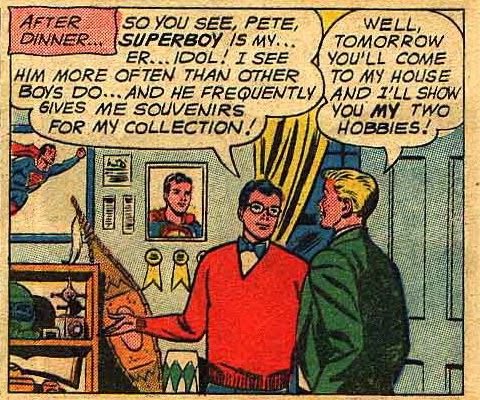
He offers to be Clark's pal, but the Boy of Steel is too worried about protecting his secret identity.  Fortunately, Ma and Pa Kent intervene, inviting the new chum to dinner.  After the meal, Clark shows off his hobby:

As he would later to Pete.

Billy later shows off his own hobby, which is creating miniature replicas of famous structures, such as the Eiffel Tower, the Empire State Building, and the Golden Gate Bridge.  Pete has different pastimes: acting and detective work.

Now that they are friends, Clark finds himself (as Superboy) often saving Billy from perilous situations:
As he also did with Pete:


Which leads inevitably to some awkward moments:

Clark is disturbed to learn that his new pal is checking Superboy's measurements:


Which leads him inevitably to the conclusion that his supposed buddy is plotting to betray him.  But fortunately there is an innocent explanation:


Pete Ross went on to become a recurring character in the DC Silver Age, albeit a minor one. As I have discussed earlier, he became the only person other than Ma and Pa Kent to know Superboy's secret identity.  Billy Todd?  As best as I can tell, this was his only appearance.

Update: Kirk House pointed out in the comments that in Action #457, Pete Ross's son apparently lost his will to live.  Only one thing could save him; if Superman divulged his secret identity to the young lad.  The story is pretty good; ironically the many times that people have suspected Clark Kent as Supes works against the disclosure, as Jon Ross cites those incidents for his skepticism.  Fortunately he has figured out another way to prove it that Clark had not protected himself against:

There are a couple of interesting ironies about this story.  First, Pete could have told his son that Clark was Superman, or at least confirmed it, except that Supes himself was unaware that his boyhood chum knew the truth.  Second is that the many times Clark had been suspected of being the Man of Steel and managed to deceive people into reconsidering actually worked against him.  This echoes a Golden Age Batman story where Bruce Wayne lost his position as the guardian of Dick Grayson, in large part because he had convinced the public that he was a dissolute playboy.

The concept of someone making a deathbed request to learn a superhero's secret ID had been used several times already, including at least two Batman tales and one in Jimmy Olsen:


More about →