Lois Lane, Foreign Correspondent

Người đăng: lecuongle on Thứ Hai, 28 tháng 11, 2011

As you recall, in my last post, Lois was subjected to an inhumane experiment by Editor Perry White. He got Lois' friends, her sister, and even the warden at the state prison, to go along with a hoax where everybody pretended they'd never heard of a Lois Lane. But it was all for a good reason, we were assured. Perry was testing her to ensure that she had the ingenuity to handle the tricks and intrigues of foreign agents. The ending of the story promised that in the next issue we would see Lois abroad, handling difficult assignments with aplomb.

But in Lois Lane #37-39, no such story appeared. In the letters column of #39 someone remarked on the missing adventure:
And the tale finally arrived in LL #40:
Okay, so what's Lois' dangerous and thrilling assignment, for which she required such careful vetting?
!!!! No kidding, she was assigned to do a feature article on a wax museum? And actually, that's not some cover story; that's really her whole reason for visiting the tiny European country of Brozna.

Granted, the story develops rather oddly from there, with Lois apparently marrying a very eligible local Duke, although she cannot remember the ceremony as she was involved in a monorail crash while setting out on their honeymoon which gave her a mild case of amnesia. She decides that she doesn't really want to be married to the Duke, but when he threatens to kill himself:
While back in Metropolis, Lois receives wedding gifts from all her old friends, but:
That's even worse than re-gifting! But the roaring fire causes something inside her husband's luggage to melt; it's a bunch of masks that he wears to deceive people. It turns out he was Brozna's Nazi collaborator during World War II, that he used his supposed status as Lois' husband to escape to America, and that they never actually were married. Instead he had drugged her and faked the monorail accident, convincing her that she simply forgot their wedding due to her injuries.

So even though Lois was supposedly tested so that she would be able to withstand the best tricks enemy agents could throw at her, she still was duped by the Duke! Fortunately Superman is around to save her, and she gets a big scoop.

Comments: How bad must this story have been the first time around?
More about

Frew #1615 - The New Abbess

Người đăng: lecuongle on Chủ Nhật, 27 tháng 11, 2011


Writer: David Bishop
Artist: Cesar Spadari


Download


Scanned &edited by "Kit Walker".
All thanks & credits go to him.
More about

Frew #1614 - The Scapegoat

Người đăng: lecuongle


Writer: Claes Reimerthi
Artist: Sal Velluto


Scanned &edited by "Kit Walker". 
All thanks & credits go to him.

P.S. 1615 & 1612 are coming very soon.
More about

Lois Lane #36

Người đăng: lecuongle on Thứ Bảy, 26 tháng 11, 2011

The opening story is The Day Lois Lane Vanished. It's a very standard DC plot, where the protagonist suddenly finds that nobody remembers him or her:
Offhand I can think of at least two stories where Batman faced the same puzzle; Am I Really Batman from Batman #112 and The Batman Nobody Remembered, from World's Finest #136. There are basically two answers to the puzzle; either it's a hoax for some reason, or the protagonist has somehow ended up in another dimension. In the first Batman story it was a plot to keep Batman awake for 24 hours because a villain had poisoned him with a drug that would kill him if he fell asleep anytime in the next day, and in the second Batman story it was another dimension. In the Lois Lane story:
The story is also remarkable for the efforts Lois goes through to prove to herself that she really existed; after her co-workers and sister deny her reality, she even visits Lex Luthor in prison, but he also claims to have no memory of her. As you can probably guess from that above panel, the story reaches a climax in tragedy, as Lois apparently throws herself off a cliff, convinced she is insane. Well, no. See, she realized that Lex Luthor was in solitary confinement, and therefore the warden would never have allowed her to see him. So she pulls a gag on everybody by making them think she's died. That Lois, such a kidder! And in the end:
But that is a tale for another time. For the second story, we get:
No particular surprise; everybody gets that wrong. Dr Jekyll was the good guy; it was Mr Hyde who was the villain in the classic Robert Louis Stevenson tale. Lois is addressing the first meeting of the Lois Lane fan club, lecturing them on the various effects that Red Kryptonite has had on Superman, when suddenly:
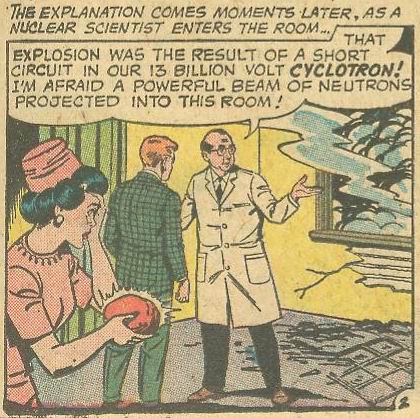
The LL fan club holds their meetings in a room next to a cyclotron? Anyway the particular specimen of Red K that Lois was showing off to her admirers was one that had turned Superman into a Jekyll-Hyde creature, and Jimmy wonders if it will have that effect on Lois due to the neutron beam. Good guess:
Later, she cuts off Lucy's hair:
And when she turns on the TV to see Lana Lang talking about her Superboy memorabilia, she becomes fanatically jealous:
But Lana refuses to press charges and Perry offers to take responsibility for Lois. When she changes again, to save himself from her he offers her a chunk of Green K. She goes to an auditorium to kill Superman (as shown on the splash), but once there:
See, it wasn't really Green K, but a chunk of "Good Samaritan" Red K, which turned Lois back into her normal self. And that wasn't really Superman, but a puppet manipulated by a couple of Lois' talented fan club members. The finale is the cover story, and it's an imaginary tale. Superman comes up with a way to give Lois permanent superpowers and finally marries her. They have twins (many of the imaginary tales feature this outcome, for some reason). Lana is of course devastated, but she wears the mask:
She volunteers to test an experimental time machine, which sends her into the future. She meets up with Superman in the future, who falls immediately in love with her, although she resists him at first, thinking he's still the man she knew. He explains:
Hmmm, given that we saw Lois and Superman had a son, wouldn't their grandson be Superman III? Assuming of course that there weren't three generations of only girls in the family.
They fall in love and get married... and that's the end of the story. Rather dull and unsurprising given the cover.

Overall the issue was entertaining, particularly the opening story.  I will have to check up on the following issue to find out about Lois' adventures as a foreign correspondent.
More about

My Greatest Adventure #73

Người đăng: lecuongle on Thứ Hai, 21 tháng 11, 2011

My Greatest Adventure was a DC series that mostly featured first-person tales of derring-do. The opening tale is the cover feature, and it's a definite corker. Mitchell, the "sahib" on the cover, has tried and failed three times to climb Nanda Devi, the tallest mountain entirely in India, and the 23rd tallest in the world. When he turns back from the third attempt, he meets an aged monk:
As a young man, the monk had been entrusted with a prayer wheel that he was supposed to deliver to the lamasery. But on spotting the summit so close, he decided to try to become the first to reach it. Leaving the wheel behind, he nearly reached the peak, but was driven back by fierce weather. Lamed by frostbite, he was unable to reclimb the mountain to retrieve the prayer wheel, but he had discovered a way around the tricky ledge that had foiled Mitchell. He tells the latter the route, on the condition that the climber bring back the wheel on his descent.
They reach the summit, but Mitchell reneges on his promise and during the descent the mountain strikes back (as shown on the cover). Finally he decides to return for the prayer wheel:
Comments: A terrific story by Bob Haney and superb art by Lee Elias. Mitchell may be based loosely on Hugh Ruttledge, who indeed failed in his three attempts to summit Nanda Devi. Incidentally, the letters page includes some comments about Haney's qualifications to write this story:
The second story is about a man surveying a cavern. He discovers a pool which has a strange effect on him:
He heads back to the nearest town, where he finds himself compelled to steal a carboy of heavy water. Once again the pool works its strange magic, and he returns to town to steal some radium. This time he discovers that an alien has controlled him:
He steals the gyroscope and the alien is able to leave Earth behind. Comments: The story is nothing special, but the art is by Gene Colan. The finale is drawn by Mort Meskin. We Fought the Lost Kamikaze Battalion is a pretty standard story about some folks visiting a Pacific island and encountering some Japanese soldiers who do not accept that the war is over; I have discussed these stories before. However, this one does have a definite twist ending:
And thus:
Comments: Love that ending; it comes completely out of the blue.

One oddity to note: This title was at the time (late 1962) edited by Murray Boltinoff. I am not sure if this was the first book he officially edited but I do know that the vast majority of DC non-romance titles at the time were edited by Jack Schiff, Robert Kanigher, Mort Weissinger and Julius Schwartz.
More about

The Iron Giant

Người đăng: lecuongle on Thứ Năm, 17 tháng 11, 2011

Mark Engblom recommended this movie a couple years back but I never got around to watching it.  Then the other day I found out a friend of mine had the DVD and I borrowed it.

If you've never seen the movie, I highly recommend it.  A young boy named Hogarth befriends an alien robot who has crash landed on Earth.  The robot has no memory, and so the boy teaches him English and at one point gives him a comic book to read:

This becomes a key plot point in the movie, as the giant begins to model himself after Superman.  At any rate, the cover looks real enough that I decided to poke around.  Since the story is set in 1957, I figured it had to be from sometime around then.  Sure enough, it's Action #188, from January 1954:

Aside from a few liberties taken with the coloring, it's a reasonably accurate reproduction, even including the mention of Tommy Tomorrow at the top.

Incidentally, this is the second movie I've seen recently that included comics as a major theme; Catch Me If You Can with Leonardo DiCaprio and Tom Hanks prominently featured a number of issues of the Flash.
More about

Mad Man

Người đăng: lecuongle on Thứ Hai, 14 tháng 11, 2011

Between the ages of about 9 and 13, virtually every kid in the country went MAD, and I was certainly no exception. Unlike the comics, I didn't hang onto my collection, but fortunately the folks at EC put out a massive CD set about 10 years ago, with something like 500 issues of the seminal American humor magazine. Here are some of the bits I remember reading back then.

For some reason, the song parodies always worked with me:
I remembered that one virtually word for word except that in the first stanza I recalled it being "then you know you've got..."

The Spy Vs. Spy series was always hilarious, and I suppose most of us remember that the morse code under the splash reads "By Prohias". But how many remember that there was a short-lived third spy, the grey woman?
I suspect she was eliminated because she always won, upsetting the general balance between the black and white spies. Of course, after awhile, even the dullest reader must have figured out that whoever won the splash battle clearly lost the panel bout, and the guy who seems to be winning in the first three panels always dies in the last one. BTW, there was a pretty entertaining computer game for the Commodore 64 back in the 1980s featuring Spy Vs. Spy.

Everybody remembers the terrific movie and TV parodies, often illustrated by the incomparable Mort Drucker:
There were lots of funny bits involving photographs. For some unknown reason, this one just popped out at me:
For the life of me, I can't imagine why I remember that.

The covers were mostly forgettable; even though I bought lots of issues in the 1964-1967 timeframe, this is the only one I specifically remember:
And it's not because I got the joke; it's because I saw it at a friend's house and somebody had poked holes in poor Alfred's eyes.

Of course, MAD did lots of stuff we didn't understand; a lot of the political humor went right over my head. But that was okay; we were used to not getting the joke all the time, and MAD prepared us for National Lampoon in the 1970s, where, for the most part, we did.

MAD had so much more; those terrific little gags in the margins that I'd need a magnifying glass to see nowadays. Or Dave Berg's endless "The Lighter Side of..." series. Or MAD's maddest artist, Don Martin. Or those amusing fold-ins on the inside back cover.

I'm sure that most of you know that MAD actually started as a regular-sized comic book. One thing that I was not aware of until recently was just how many imitators there were. Everybody remembers Cracked, but there were easily a dozen others.
More about